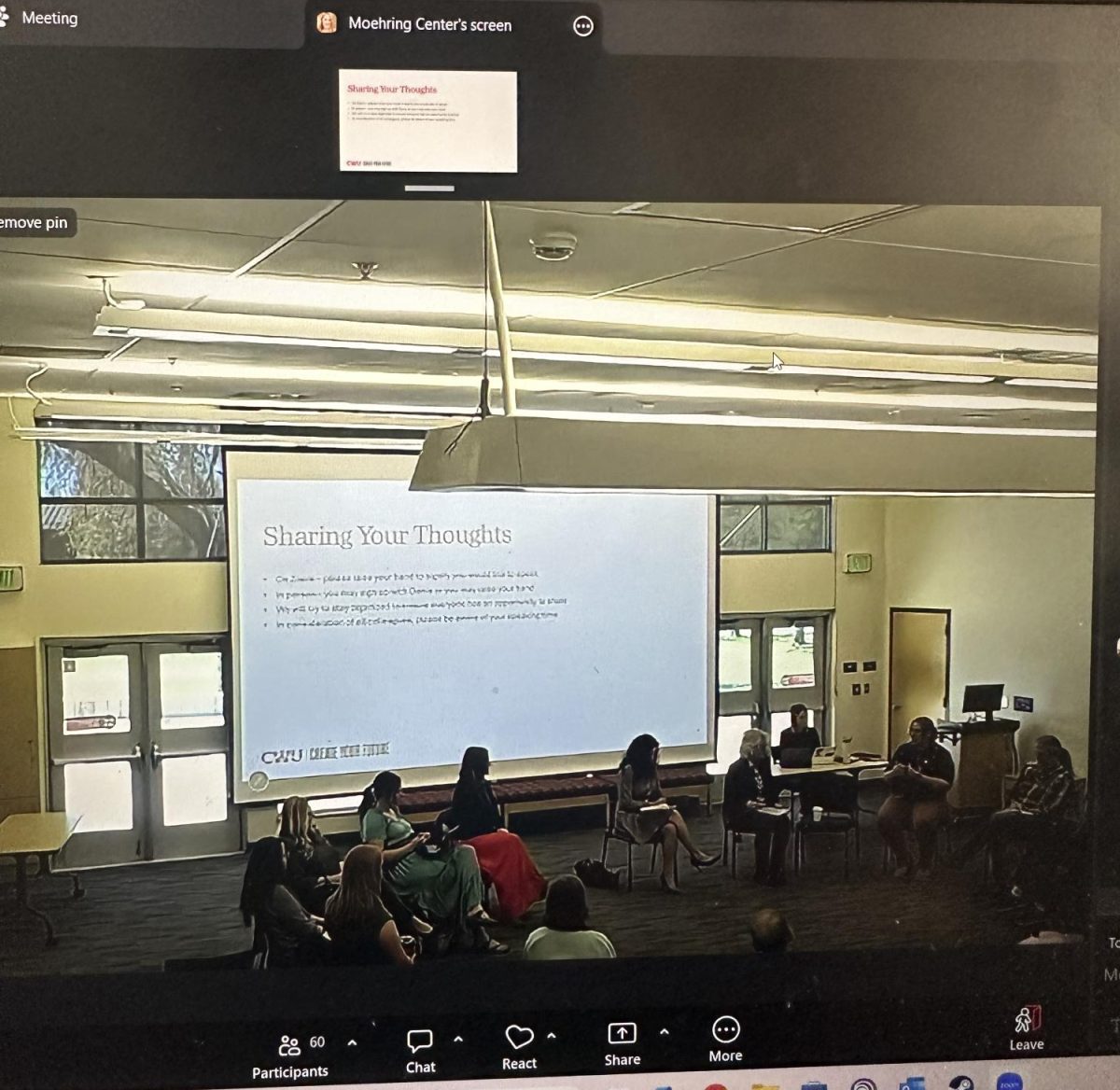
Faculty, staff and one student shared feelings of disappointment and frustration alongside expressions of pride and realism at three public listening sessions hosted by the CWU Board of Trustees (BoT) between Thursday and Monday.
In an email announcing the sessions, the BoT stated they were to “help inform the trust-building process for members of the university community and support continued progress as we move through this difficult work together.” The difficult work refers to fallout from the faculty vote of no confidence in President Jim Wohlpart on Feb. 18. The hour-long sessions, two of which went over time, were held on April 30, May 1 and May 4, in person and over Zoom.
At the sessions, a variety of concerns were brought to the BoT’s attention, including the process of rebuilding trust, class scheduling, advising turnover, staffing attrition, not listening to faculty voices and more. In contrast, a few community members shared stories of how the university and Wohlpart have helped them.
The BoT maintained that its plan for rebuilding trust is moving forward, a sentiment Gladys Gillis, a member of the board, echoed at the April 30 session. “If you haven’t seen the plan that we released, I want to brag about it because I’m frankly excited about it, because I think it goes to trust building, and it also goes to trying to pull the wet blanket off of anyone who’s losing their sparkle.”
April 30 Session: Reciprocal Trust, Advisors and Gratitude
The April 30 meeting returned multiple times to the idea of a sparkle. Faculty shared that they felt there were members of the university who had a “sparkle” that they thought could never be dimmed. This year, they said, they have started to see the sparkle being dimmed.
Shaffer Claridge, senior lecturer in the Law and Justice Department, talked about the process of rebuilding trust and stated that trust needs to be reciprocal. “I think the Board has expressed that the next year-ish will be about rebuilding trust,” Claridge said. “I think that’s important, and I think that is possible, and on a fundamental level, I trust that everybody who works at CWU is invested in its success.”
“I think that being able to work through difficult things requires trust, and I hope that we’ll be able to do that from a faculty perspective,” Claridge continued. “It’s important to recognize that trust has to be reciprocal, otherwise it’s just obedience.”
Gillis responded to Claridge by re-sharing what some of the rebuilding process will look like. “There’ll be a standing spot (at BoT meetings) for students, there’ll be a standing spot for the Faculty Senate, there’ll be a standing spot for staff,” Gillis said. “We plan to do some work around the Shared Governance, because it seems to be at the heart of many of the issues. So we’re bringing in an expert on that, and also trust building so that we put these things in place, because we see that this is an important issue, and we want to hear and we’re so glad again that you’re here today.”
Associate Professor in Sociology Griff Tester said that one of the reasons he feels faculty isn’t being heard is because listening is not a priority at university meetings. “Most of us know at this point that when we’re in a meeting that’s being led by the President or the Provost, that often they already have their mind made up. They already have ideas about what will happen, and that we are simply sitting in that room because they need to say that they called us together and they listened.”
“At this point, it feels like a complete waste of time to show up to those meetings, although I still do because it’s important and I want to be there,” Tester said.
This sentiment was reiterated by Gretchen Lohse, an administrative assistant for the Communication Department (and Business Manager for student media, including The Observer), who went on to discuss high turnover rates for academic advisors at the university, citing overwork and underpay as a stress being put on their positions.
“We had our advisor quit recently because of burnout,” Lohse said. “While they’re going to rehire for that position, there’s nothing to stop that from happening again, because that’s happened with the last two advisors that we’ve had. I’ve worked here for just over three years, and I will now be on my third advisor once someone has been hired.”
One staff member took the listening session as a chance to share a perspective on the university, connecting it to her own story and the many opportunities that have been provided to her. “I owe my career, and I owe who I am right now to this institution, to the administrators that have been here, to the faculty that have been here, to the staff that has been here,” said Christina Denison, executive director for the Douglas Honors College and McNair Scholars Program. From “Temporary Office Assistant to Executive Director, this institution has provided opportunity after opportunity, and at no point have I ever felt that I’ve been left behind or that I’ve been unheard or unseen.”
“I just want to put out there that, yes, there’s this pall, but there’s so many great things happening here, and I would like us all to have some balance when we’re having these conversations,” Denison continued. “I don’t want to discount anyone. I don’t want to be accused of being a Pollyanna. I don’t want to. I’m not blind to what’s happening. [But] there’s so many good things, and I feel like my experience is one of those good things.”
May 1 Session: Student Connections and Community
Many of the May 1 session attendees had a common goal of wanting to establish a stronger connection between students and staff, while improving the communication between faculty and higher-ups. Over 30 people attended the session, many staying until the end. Staff and Faculty also shared concerns over lack of community.
Senior Lecturer of Information Technology & Administrative Management David Douglas spoke about the importance of voices being heard. Douglas brought up the idea of creating strong communication networks between staff, the BoT and Wohlpart.
“The vote of no confidence has taken place. The President acknowledged missteps. Mediation is in process to move forward. Those are meaningful steps. So the question now is not what happened, in my view, the question is, how do we move forward,” asked Douglas. “Moving forward does not mean forgetting, moving forward does not mean ignoring concerns. It means engaging in a way that creates a path toward stability, trust and progress for the people that depend on us the most, which is our students.”
Professor of Literacy Sharryn Walker touched on the importance of family at Central, highlighting the bonds she had with previous CWU presidents.
“I met President Nelson at athletic events and alumni meetings and functions. President McIntyre was one of the first people to seek me out when I came here on a tenure-track position, and greeted me by name when she met me elsewhere. President Gaudino greeted me by name at different receptions he held here on campus and also at farmers’ markets. I felt seen and valued by those connections, by the people who make up Central’s culture,” Walker said.
“My two encounters with the current president, both of which I initiated, led me to feel unseen and voiceless,” Walker continued. “The suggestion that we should be more like another university from which he previously came, to me suggests that inroads to him becoming part of our culture was ignored.”
Kara Gabriel, the President of the Faculty Union and professor of Psychology, addressed the abundance of uncertainty across campus clubs and organizations about the limiting of free speech. Gabriel also spoke about open communication and promoting transparency between faculty and students.
“One of the things the trustees have focused on, as we introduced this session, was that this is supposed to be a safe space where individuals express their concerns, and one of the roles of the union is to try to get voices heard when individuals do not feel comfortable expressing their voice,” Gabriel said.
“Yesterday, the Union Vice President expressed the fact that The Observer (see Feb. 12, 2026 issue) has documented a culture of fear and retaliation on campus, and expressed that it would be very nice if, for example, the executive leadership team members would realize there is power differential, and perhaps recuse themselves from these sessions or not,” Gabriel continued.
May 4 Session: Retention and Professionalism
The May 4 meeting focused on the topics of retention and the professional relationship between administration and the faculty body. A few of the same faculty from the May 1 meeting elected to speak again, with most attendees staying until the end.
At the meeting, grievances were raised regarding CWU’s ability to maintain its numbers of staff and students as well as the way both administration and Wohlpart interact with faculty.
Kara Gabriel opened the session with a metaphor regarding the relationship between faculty and administration in the face of low student retention and finding solutions to that problem. “Imagine running a luxury bus company. If ridership drops, you might change pricing, but you wouldn’t immediately change the routes, the bus types and the scheduling all at once. You would pause, assess whether the price change worked, and then decide what to adjust next. That’s the core of what we’re asking for when faculty and staff talk about change fatigue,” Gabriel said.
“We’re not resisting necessary change. We understand that higher education must evolve to attract and support students,” Gabriel continued. “Faculty and staff are ready to engage in meaningful change, but for that change to succeed, it must be evaluated, and the people closest to the work must be part of that evaluation. That’s how you build not just better outcomes, but trust.”
Junior Anthropology Major, Maddy Reynolds, brought a student’s perspective to the impact that staffing attrition has on the qualifications of a CWU graduate. Reynolds spoke about the job market graduates will be facing, citing that based on the data she collected, “only 30% of 2025 graduates secured full-time employment related to their field, which significantly decreased from 41% in 2024.” She added that 42.5% are “underemployed,” which means that they work jobs which don’t require a university degree.
“The board should focus their attention not on program length, but on the matter that is [impacting] students across disciplines, which is faculty attrition, which is defined as the gradual reduction of staff due to voluntary or involuntary resignations, retirements or deaths, often without immediate replacement, which is a plight Central has suffered long before my time here,” Reynolds said.
“What has Central’s administration done to rectify this? They have shunted this responsibility onto the backs of our deans with the explicit message that only positions in critical condition should be filled,” Reynolds continued. “That leaves gaps within the faculty, and ultimately causes current faculty to increase their workload and even [go] so far as to work in areas that are not their specialties. This reduces the quality of education that Central offers.”
Tim Englund, interim chair of the Computer Science department, and Kate Mastruserio Reynolds, literacy professor, expressed concerns surrounding the administration’s allocation of budget towards marketing and rebranding rather than admissions and recruiters.
Other speakers focused on Wohlpart, his relationship with staff and the role he plays in CWU’s broader community. Bob Hickey, a now-retired professor of 24 years and former faculty union president, spoke about Wohlpart’s leadership.
“After President Wohlpart had been here for a few months, I reached out and said, ‘Hey, I’d like to talk to you. I might have a little bit of insight. I’ve been here for just 20 years,’ Then, the response I got back was, ‘I do not meet with individual faculty,’” said Hickey. “That told me two things. It told me that he did not want to deal with faculty any more than he absolutely had to, and it told me he had no interest in current or historical traditions.”
Hickey went on to say that he felt Wohlpart and his administration hadn’t done anything significant to improve “either the quality or quantity of our students’ education.”
Likewise, Teresa Divine, a Law and Justice professor, said that the current administration has lost her trust and had, in her opinion, done more harm than good, particularly in terms of how diversity has been handled. “This president lies, outright, blatantly lies, and I really don’t know how to show it or prove it, but this has been a really awful time, and to a point where we have been turned against each other, like faculty of color against each other,” Divine said. “Then for the President to say that this is the most diverse administration ever, it’s not true. This is the worst time. This institution is so anti-black.”
“I think if we voted [on the no confidence] today, that vote wouldn’t be 80%, I think it would be 90% because nothing’s been done to prove trust, nothing’s been done to do anything to not to be disrespectful,” Divine continued.
However, not everyone was critical of Wohlpart. Alexandra Collyer, assistant director of mental health, called for faculty and administration to move towards “solution-oriented thinking,” rather than just speaking about concerns, complaints and accusations. She was also critical of the idea of removing Wohlpart from the position of president, believing it to not be a viable solution.
“I do not truly believe this would actually address any of the issues individuals are sharing. I have heard many people state that they do not feel that the President is relational, or that the listening and relationship they have experienced feels performative,” Collyer said. “While this has not been my experience with President Wohlpart, I’d also like to say that a University President’s job is not to be our best friend-in-chief. Their job is to keep the doors open and raise the profile of the university in the eyes of the public, therefore securing both funding and enrollment for the future with an eye to guiding internal structures for current students, staff and faculty.”
Collyer shared insight on what she felt an actual solution to many issues would be. “What is needed is an internal structure that aids us in our ability to do better, and does so in a way that supports smaller numbers of individuals with greater connection points and consistent communication streams,” Collyer continued. “The only way to make those things happen is by setting aside intentional time to be together and work together. The more we partner, the more we address internal communication structures, the more we see ourselves in everyone’s work instead of just our own, the more capable we are to do better, even with less.”
Collyer was also critical of The Observer’s own coverage, believing that it has engaged in “gotcha journalism” and that it should instead be “creating a tone in the campus paper of kindness, good, reliable information and celebrating CWU.”
The session concluded with a final word from Hope Amason, associate professor in the Department of Anthropology and Museum Studies, who expressed appreciation towards the BoT for holding these listening sessions.
“I’ve never met a faculty who didn’t want to see students and staff involved in shared governance with us, that sounds amazing, and this is what that might look like, actually,” Amason said. “This is what that actually might look like. This could be the grounds for building something like that.”