



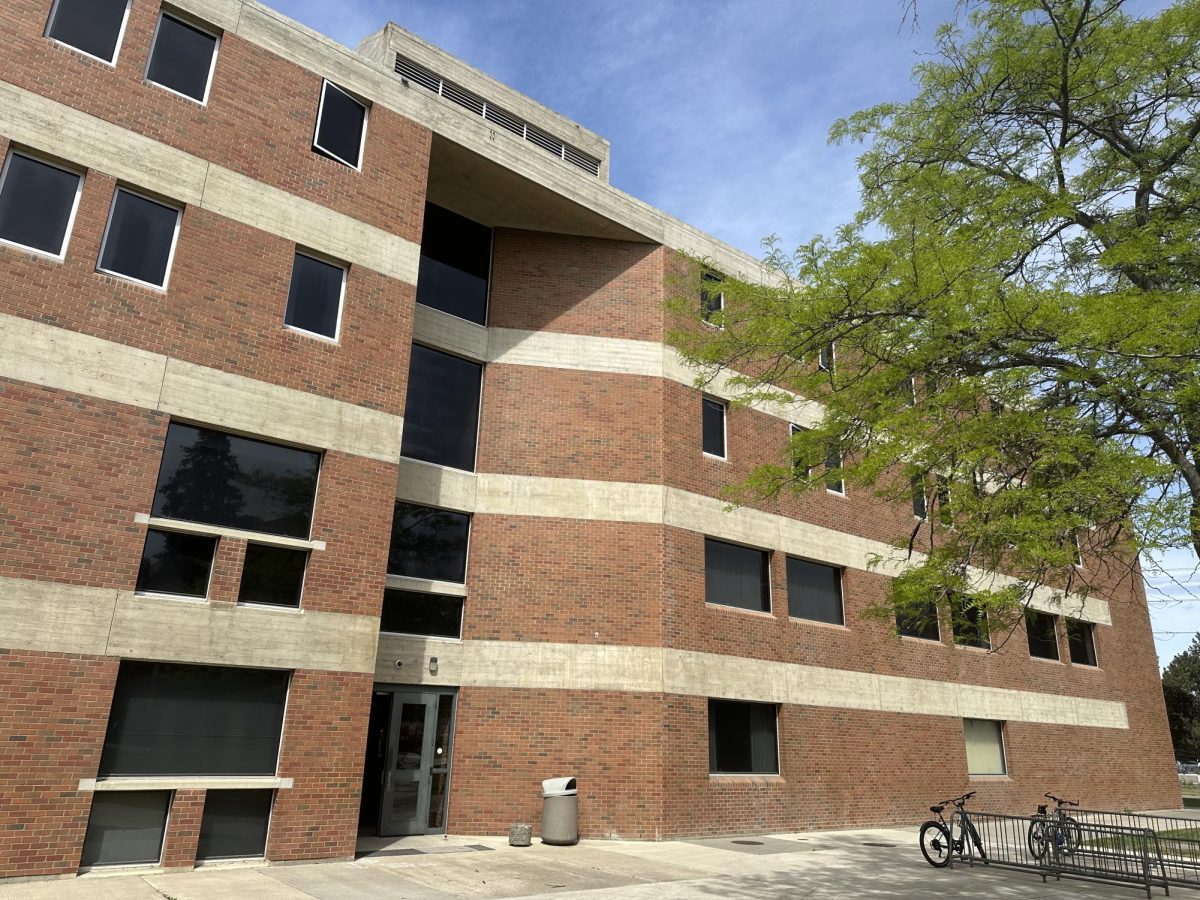
Students and Faculty alike have faced “sweltering” heat in Farrell Hall, which is scheduled to be demolished this summer. Temporary air conditioning (AC) units have been brought in to cool the building, but in-classroom heat has forced some professors to react.
Barbara Ann Rieffer-Flanagan, a professor of Political Science and associate chair, had her class moved out of the building following the increase in temperature. “It was over, at least, 82 degrees registering. It was sweltering, and the students were incredibly uncomfortable and frustrated with the situation,” Rieffer-Flanagan said. “One student in one of my classes sort of mentioned, ‘Is there any way to switch classrooms, or anything along those lines?’ And I said I would look into it.”
So Rieffer-Flanagan did, and for the past two weeks her class has been hosted in Dean Hall. “It was just not a good environment for student learning,” Rieffer-Flanagan continued. “I took the next steps to move the class for the rest of the quarter to Dean Hall, so that’s where I will be, and hopefully that helps the students do better in class or not melt.”
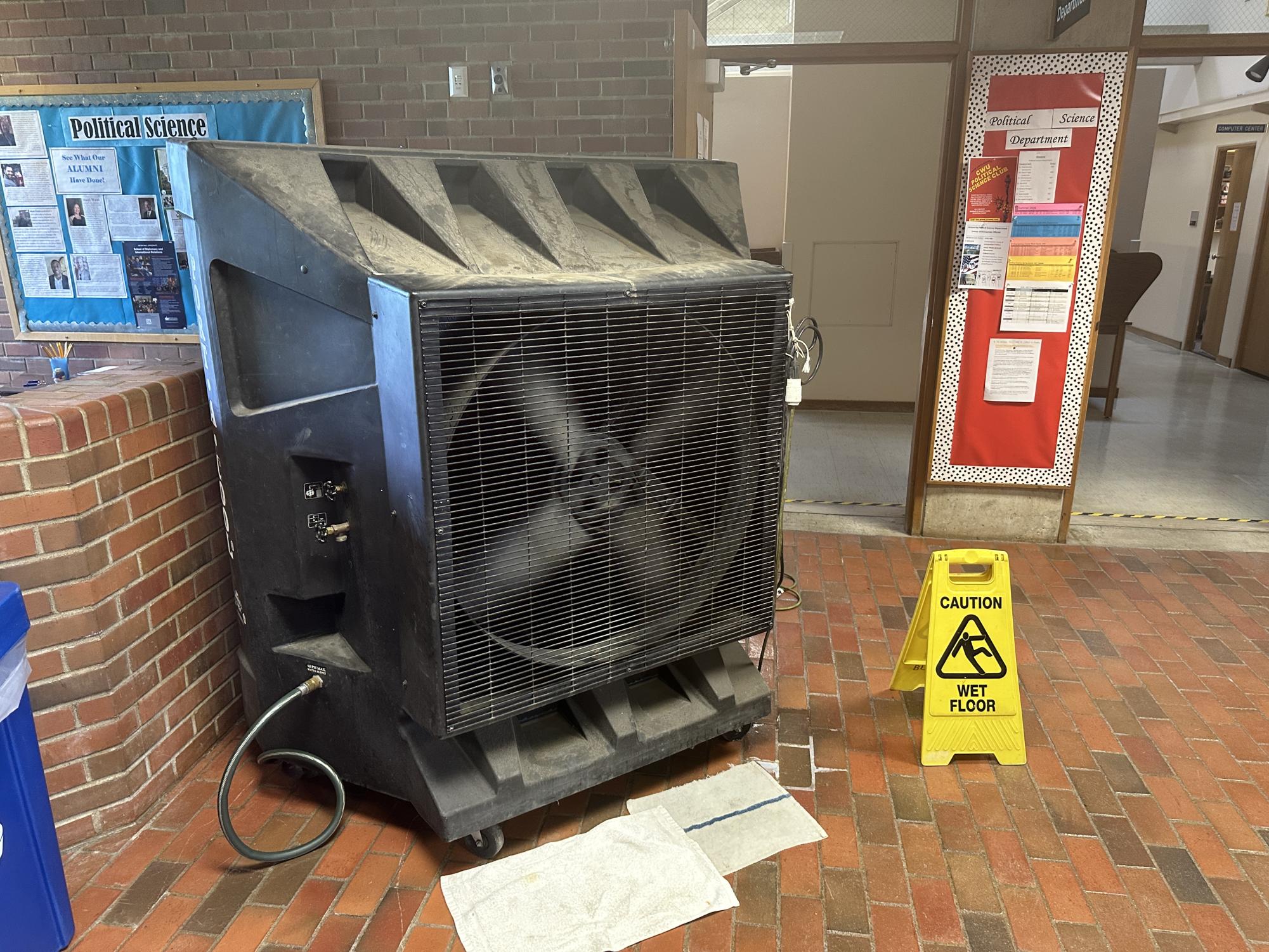
Following the increase in temperature, temporary AC units have been placed around the main walkways of the building, but Farrell Hall’s main AC system has been shut down since the beginning of the quarter.
According to David Leder, associate director of strategic communications, the reason for the lack of building-wide AC is that the Facilities Management Department (FMD) “evaluated the cost benefit of doing an expensive repair of the mechanical cooling system in Farrell Hall versus the length of use, and they determined that it would be cost prohibitive to make a significant investment in an end-of-life system scheduled for demolition in less than two months. The temporary AC units are intended to alleviate some of the discomfort until all occupants of Farrell are relocated by the end of June.”
This situation in Farrell comes at the same time that Mitchell Hall was closed following a roof leak that resulted in flooding and water damage on both the first and second floors.
According to Leder, staff were temporarily relocated for safety. “We are currently assessing the extent of the repairs needed and evaluating whether long‑term relocation will be required for the departments previously housed in Mitchell Hall,” Leder told The Observer in an email. “Campus updates will be shared as more information becomes available and the situation progresses.”
Faculty and Students React to the Heat
Since the heat began to build in Farrell Hall, multiple denizens have stated that they have found it increasingly hard to deal with. Nuhamin Regassa, a second-year student majoring in Political Science, described the heat that had built up prior to a fire alarm going off in the building.
“Before the fire alarm had gone off, there was an intense amount of heat that was near suffocating. I even remember drinking an increased amount of water just to stay cool,” Regassa said. “I find that the school doesn’t really support the Political Science department because we’re small in number, but also just because we’re to be moving to the NAC (North Academic Complex) soon, doesn’t mean anyone could experience health-related issues due to the heat, like heat strokes, etc.”
Shaffer Claridge, senior lecturer of Law and Justice, said he has also been faced with the challenges presented by the building’s high temperatures.
“It’s been hard. The rooms are pretty small, and we’ve got lots of students in them, so in addition to the heat from outside, heat generated by the lights in the projector, just this many bodies in a room makes it hard,” Claridge said. “I sweat every single class period. Mostly, though, it’s the students who report being unable to focus and really feeling pretty miserable.”
Claridge added that he does think steps are being taken to make things easier on students and that he was grateful for the portable cooling devices provided, but they also are “pretty loud and disruptive” themselves.“I think everybody’s doing the best that they can. It also is just kind of a sad way for the building to go out,” Claridge said. “I’ve taught here my entire career. I don’t know exactly how long the Law and Justice Department has been here, but it’s been, I would guess, 20-plus years. It’s being torn down. We have a beautiful new facility, but I think we’d all looked forward to one last hurrah in this building, and it’s kind of sad that this is the end of it.”
Another Political Science major, Alina Lombardo, a third-year student, described how the heat affected their classes this quarter, with half of them having been moved out of the building.
“At the start of the quarter all four of my classes were in Farrell Hall and two of them had to be moved due to complaints and exhaustion,” Lombardo said in an email exchange with The Observer. “Everyone has complained and is unhappy with Facilities not turning on the AC, just because Farrell is being torn down is not a reason enough. So many clubs, and classes, and professors, and PEOPLE are in Farrell for several hours every day and this lack of regard for students and staff (who are the “north star” of the BoT, remember) is embarrassing, at least to me.”
Lombardo also explained that although the fans in the building have cooled things down “a bit,” they have also created new problems. “Several of my friends (as well as myself) have complained about the noises caused by the fans, which can be distracting for classes, as well as a sense of ‘wet air’ caused by the fan on the first floor,” Lombardo said. “It’s hard to describe, you’d have to go in and experience for yourself.”
Rieffer-Flanagan explained that other faculty in the building have also talked about how they have been forced to handle the heat, but that for her, there weren’t that many options. “Other faculty members have talked about how hot it is teaching in this building as well, and one had sort of encouraged his students to dress lightly … but I was not going to ask my students to do that,” Rieffer-Flanagan said.
“One of my students is a Muslim woman and I would never, ever be like ‘you need to change your attire,’ which is key to [their] religious beliefs, because of the temperature in the building,” Rieffer-Flanagan said. “So my response was, just get me someplace else.”
Political Science major Logan Williamson was one of the students whose class got moved out of the building following the heat, and remembered the whole experience as disruptive.
“The heat prevented me from being able to properly pay attention and participate in class,” Williamson said. “I feel rather forgotten by the university. I understand that the building will be demolished, but it is still actively used and occupied by the Political Science and Law departments. By refusing to pay for maintenance and air conditioning this quarter, it demonstrates to the student body that the University prioritizes profits over its students.”
“Additionally, my professor having to make the decision to move to Dean Hall has disrupted my and many of my friends’ abilities in class and attendance,” Williamson continued. “It is a very disappointing situation all around.”
Moe Alkhazraji, a Political Science major, said that while he does not have any personal problems with the heating, he thinks that CWU needs to do more to support its faculty. “If the school administration were worried about costs, which they should not be as I have seen with my own eyes the proposed legislative budget for CWU earlier this year, then they should perhaps cut back on handing out bonuses and salary increases to each other and instead use that money to provide proper working AC’s for their elderly professors who have given years, including missed vacations, opportunities, family celebrations and gatherings, etc, in order to be good servants and teachers to their students,” Alkhazraji said.
Lombardo argued that the burden of change should not be put on the students of the university regarding things like the heating situation in Farrell Hall. “It should not be upon us complaining for something to happen,” Lombardo said. “The university should’ve seen that there are still classes and events occurring in Farrell, and either made everyone not have classes in Farrell and start moving into the NAC, or kept the AC on until people moved out of their rooms and offices.”
Farrell Heat Mentioned at Faculty Senate Meeting
Trye Price, assistant professor of Law and Justice and a faculty senator, spoke at a Faculty Senate meeting on May 6 about the heat, stating that all he’s seen is that temporary AC units were put into the building.
“Obviously, big problems with this,” Price said at the meeting. “The only response we’ve gotten so far through the day, literally this week [May 6], is we’ve had air conditioning units being industrial ones, and [we] saw the fans. But that doesn’t address overall cooling, we’re having open windows, which results in distracting noises, and for people like me that have really severe allergies, my doctor is actually impressed with my numbers and how bad it is.”
“This is just not okay,” Price continued. “It’s a health detriment. It’s uncomfortable, and a big issue is the lack of communication, because if this would have been told to us, let’s say, last fall, when it looks like there were some decisions made above us or whatever, we could have made some alterations to classroom location. We could have given our students updates and notifications, and especially for those who need air conditioning for health reasons, allergies and such.”
Faculty Senate Executive Committee (FSEC) Chair Natashia Lindsey expanded on what she’s heard from the university following a request for comment from The Observer. “It is my understanding that the Registrar has identified classrooms across the university, across campus, and should be interacting with those faculty so that they can move their classrooms,” Lindsey said. “I asked for clarity around what’s happening with the staff around that building and did not really get an answer there.”
Story Contributions by Parker Wood




Moe A • May 21, 2026 at 12:49 pm
Outstanding job, CWU admin needs to sit down and put more of an effort into supporting their faculty and their students. This schools faculty and student body are the only unconditionally supportive backbones of the University, not only in terms of tuition and expenses, but also consistent charity and philanthropy as seen with GiveCentral.