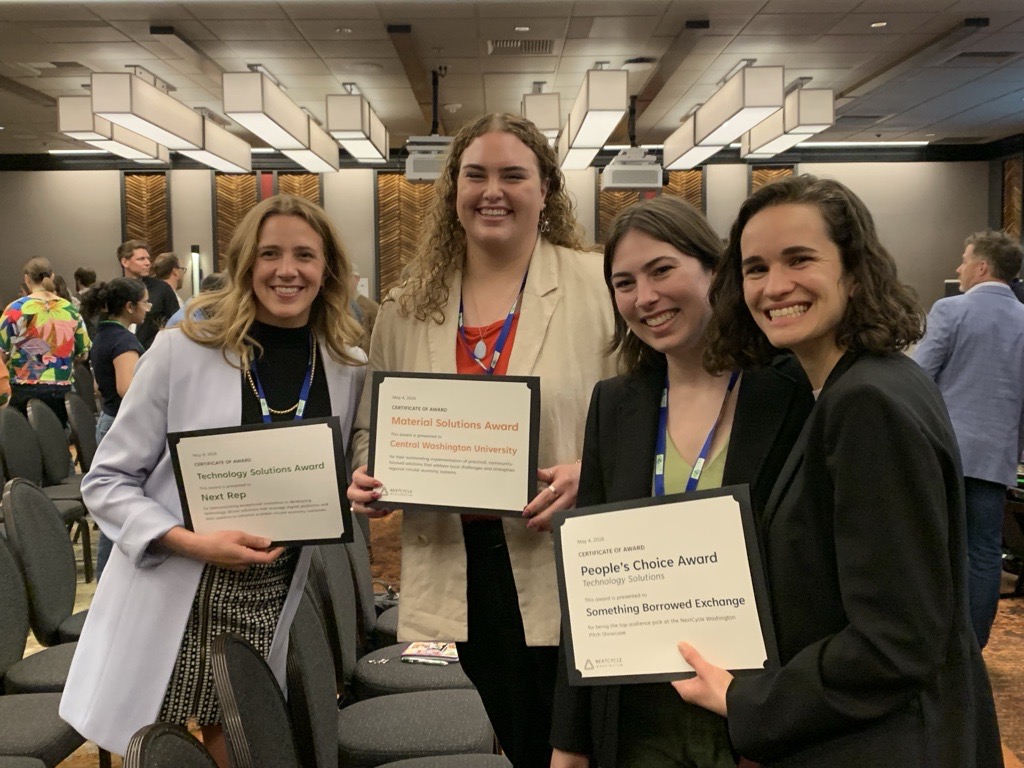
CWU Sustainability secured a $10,000 grant for their department at the Washington State Recycling Conference (WSRC) held in early May. The conference brought together industry leaders across the state to discuss the future of sustainable waste management in Washington.
CWU was an outlier from the other 15 presenters invited to the event, being the first college to attend as a presenter, represented by Sustainability Coordinator Jordan Spradlin. Student Sustainability Ambassadors Brooke Cruz and Hannah Campbell also attended on a student scholarship they won earlier this year. While the event has hosted students, it has never hosted college departments prior.
“We’re heading in a direction that not only will make the campus more sustainable and allow us to thrive for years to come, but to be that leader in sustainability, and to be known as a sustainability campus,” Spradlin said.
In early October 2025, CWU Sustainability submitted an application for NextCycle, a collaborator of the WSRC conference, with the focus on the Wildcat Compost Collective. NextCycle is funded by the Washington State Ecology Department and focuses on initiating a circular approach to waste management across Washington, including funding grants.
In January, CWU Sustainability Director Jeff Bousson, along with Spradlin and the Wildcat Farm Interim Manager Nora Jacobs, attended the Circular Accelerator Academy, hosted at the Washington Department of Ecology headquarters in Lacey. They spent three days in workshops with 15 other teams from across the state to bring their Wildcat Compost Collective proposal to life.
“We were just kind of in an odd one out a little bit,” Spradlin said. “Just coming at it from a different perspective, we’re not necessarily looking for customers, we’re not looking to make a profit, we’re looking to do this purely for the circular aspects of it.”
When they brought the grant presentation to WSRA in May, they won. “It still to this day kind of feels surreal, just because we were the only university involved in this,” Spradlin continued. “We’re looking to bring a commercial-sized composter to the Wildcat Farm, and kind of create that circular approach to dining, just more food grown at the farm with better quality soil from the compost means more fresh food for you guys in dining.”
The composting unit from Green Mountain Technology, projected to hit campus before 2028, would revolutionize the food cycle at CWU. The $10,000 grant put the first dent in the unit’s $500,000 price tag, and next year’s grant cycle is expected to be a great help in funding the initiative.
The WSRA conference is only the most recent example of CWU Sustainability’s ongoing efforts. The Student Green Fund, run through the Sustainability Department, has been scoring small wins through funding student projects rooted in sustainability. One yield of the Fund was the implementation of three Student Sustainability Ambassadors, two of whom attended WSRA.
Campbell hired student ambassadors for her Sustainability Club, which she initially conceived as a class project. “I talked to some other universities about how their sustainability programs operate … and then I implemented it,” Campbell said. “Fall of 2024 is when that started, and now it’s been two years since that has started, and I’ve been employed in this role for two years.”
Cruz, who represents the multidisciplinary aspect of sustainability, held an AI Efficacy workshop this past quarter and aims to reduce E-waste on campus, combining her two main passions into positive sustainability initiatives.
“I’m going to be a security technician out of school, I’m going to be working for a company … and they handle a lot of different company IT consulting issues,” Cruz said. “Policy is something that I’m very well versed in when it comes to that, and security planning, and data governance … that’s all really important to me, being able to have control over your own information and data.”
One project the Department has been trying to initiate since 2020 is a Reusable Container Program through Dining. The program would offer reusable containers to students from on-campus food locations. Two avenues are being explored–stainless and plastic.
“We are the largest generator of waste in the entire county, fun fact,” Campbell said. “We have all of these students who are just ordering all the time. So if we kind of were to restructure the way we do this … we would reduce waste significantly.”
“Students would invest in this almost like they do that one-time payment, and then take their container, eat their food, and bring it back, and then that charge either gets put back into their account,” Campbell continued. “They just keep the container for the whole year, and then they just keep bringing it back and replacing it.”
They’ve been collecting survey responses over the past year, gauging student interest in the reusable program to present to Dining. Sustainability offers a newsletter through their CWU page that you can subscribe to to keep up with everything CWU Sustainability.