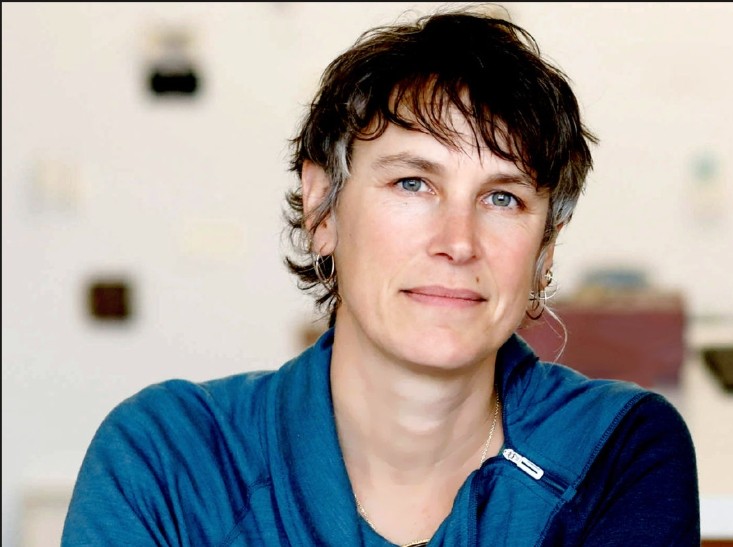
Lion Rock Visiting Writers Series welcomed naturalist, editor and poet Elizabeth Bradfield for a craft talk, poetry reading and raffle held in the Multicultural Center’s (MCC) Multipurpose Room 107 in Black Hall on April 21. The space quickly filled with aspiring poets, biology students, community members and Bradfield’s friends and associates.
Blending environmental science with the boundless reach of literary arts, Bradfield’s work blooms into themes shaped by the question of “why.” Her insistence on pushing past the “how” invites students and Kittitas County members to follow that curiosity themselves.
Growing up around the water and working on boats in the Tacoma area, Bradfield loved the curiosities nature stirred in her mind. But she also treasured the poetical elements of language and the distinct emotions words could engender within the body. She hadn’t known what a naturalist was until she met someone living the life she wanted, and that encounter sparked her determination to follow the same path.
Displaying both essays and poetry in the Cascadia Field Guide, along with her newest published collection of poems SOFAR, Bradfield read a select few, touching on an array of themes such as grief, humor and one of sensual play.
The Cascadia Field Guide project works from a plethora of poets and authors, illustrating Pacific Northwest nature spanning from Valdez, Alaska, to the northern edges of California and Wyoming, while also taking in British Columbia’s diverse ecosystems.
During her self-introduction, Bradfield quoted an idea from Wislawa Szymborska, a Polish poet and essayist awarded the 1996 Nobel Prize in Literature for her philosophical acumen. Szymborska expressed that inspiration is from the continued statement of “I don’t know.” She said, “Knowledge that doesn’t lead to new questions quickly dies out. It fails to maintain the temperature required for sustaining life.”
The importance of Szymborska’s little phrase “I don’t know” is detrimental to those who ought to stay curious and discover things that otherwise may be left clinging to the undiscovered or unknown.
Bradfield shares the cruciality of being comfortable in the uncomfortable or unknown and not restricting oneself to predetermined knowledge. She said, “Knowledge can be an armor. It can help you move into a conversation, feeling confident that you’re not going to be cut down,” But at the same time, Bradfield says it can limit curiosity and wonder.
Central to Bradfield’s message is the call to “shed some of that armor and be open and vulnerable to other ideas, other ways of knowing,” a reminder that wonder thrives when we admit how much we have yet to learn.
Upcoming events
The Lion Rock Visiting Writers Series will host Nora Wendl, a creative writer, artist and associate professor of architecture at the University of New Mexico, on May 5. Wendl will read from her hybrid memoir and architectural history, Almost Nothing: Reclaiming Edith Farnsworth, which revisits the complex collaboration between Edith Farnsworth and architect Mies van der Rohe on her floating glass country retreat, restoring Farnsworth’s role, long diminished in sexist historical accounts.
“Writing architectural history, as a memoir, changed how I’ve thought about time, history and our responsibility to the future,” Wendl said.
Later in the month, Lion Rock will welcome Sonora Jha, an author and professor at Seattle University, on May 26. Jha will read from her latest novel, Intemperance, described by Electric Lit as a story in which “a middle-aged woman starts a firestorm when she holds a contest based on an ancient Indian ritual, in which men must compete to win her affections.”
“When I write, I feel like I have lived three times as much, three more days than were my share,” Jha said.
Both events will be held in the Multicultural Center’s Multipurpose Room 107 in Black Hall.