Many people distinguish CWU from other colleges in Washington for its unique education and science programs, especially as they relate to geology and aviation. However, somewhat hidden statistics suggest that the university has another program that just might be the best.
The program that has catapulted Central to the top of the academic heap is music.
Professor of Music Jeffrey Snedeker enthusiastically described the special opportunities that CWU students have if they choose to study music and their audition into the program is successful. Snedeker singlehandedly oversees and instructs all horn students.
“They have to audition to be accepted into the music department to then be allowed to have lessons,” Snedeker said. “We work on exercises to strengthen their technique. We work on solo pieces to help them learn more about expression and things like that. And we also work on orchestral and other large ensemble excerpts for learning the repertoire that is important to French horn players.”
Students can learn to improve their skills in at least one of many unique instruments in the brass, woodwind, string, percussion, keyboard or vocal family. Brass instruments include the trumpet, the trombone, the French horn, the tuba and the euphonium. Woodwind includes the flute, the oboe, the clarinet and the bassoon. The string area includes the violin, viola, cello and bass.
Some such instruments are so unique that faculty members often have to describe them to new students. For example, students have often asked David McLemore, a senior lecturer of music and professor of tuba and euphonium, what exactly a euphonium was.
“Euphonium is more commonly known as a baritone in band,” McLemore said. “You can think of it as a miniature tuba. It’s constructed much the same way, but it’s pitched about an octave higher. So the tubing is about half the length.”
The percussion recitals especially pique the interest of Bret Smith, a professor of music education and strings. Smith said that percussion students perform “interesting recitals because they can play marimbas and xylophones as melodic instruments, as well as the drums and cymbals and all of the different things in the percussion family.”
To graduate with a music major, students must perform their favorite pieces that they learned in their lessons at a solo recital for 30 to 60 minutes on their primary instrument. Many solo recitals occur every quarter, and anyone, including students, staff, parents, grandparents, alumni and Kittitas County community members, can attend most of them for no cost.
The composition recitals also fascinate Smith. “We also have a composition studio, and they write music for anything,” Smith said. “Every quarter, they will have a recital of the student composers who get their friends to come and play their music.”
Studio recitals are another type of event that frequently occurs in McIntyre Hall, the CWU music building. For example, Snedeker said, “We have our horn studio recital, which will have student soloists and also the horn ensemble will perform on Sunday, November 16, at two o’clock in the afternoon.”
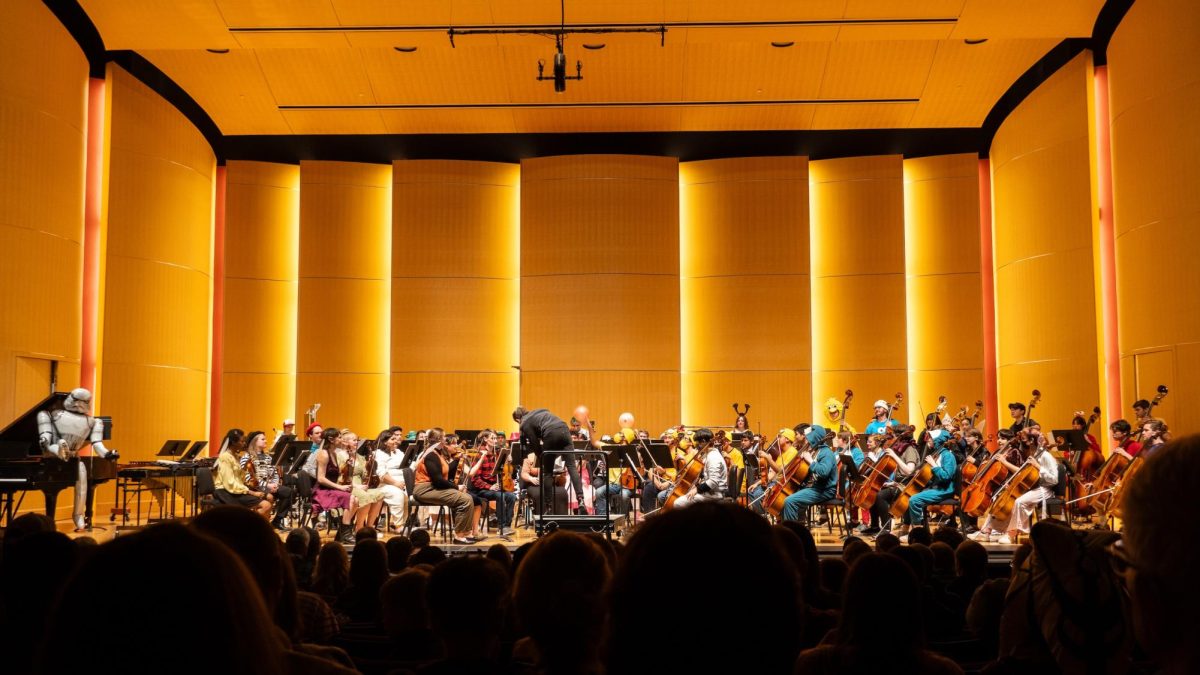
Large ensemble concerts also commonly occur in the Hertz Concert Hall, the main auditorium in McIntyre Hall. A few such events cost some money for tickets, but on behalf of the department, Smith said, “We try to keep some tickets special at reduced prices for students.”
The four choirs that CWU offers are an example of large ensembles. Chamber Choir is an auditioned group for all voice types. Vox Divina is a non-auditioned ensemble specifically for those with higher voices.
Lecturer in Choral Studies Scott Peterson directs the Wildcat Chorus, nicknamed the Wildcatters, which is a non-auditioned choir particularly for those with lower voices.
Peterson said that the Wildcat Chorus is “designed to be an entry-level choir, meaning people who want to learn about singing and learning about singing in a group would be welcome in this group.”
“Another thing about the group that I really want to stress every year, every quarter, is that we are an inclusive choir,” Peterson added. “The philosophy of the group is that singing is for everybody, and everybody should be singing. And we want people to come and be in our group.”
University Chorale is the largest vocal ensemble in the CWU Music Department. It is a non-auditioned mixed choir for any student in the university who would like to sing chorally.
Some events occur more rarely, but they still keep the faculty and students plenty busy during their time in McIntyre Hall. For example, Josephine Wells, a lecturer of clarinet, music theory and aural skills, helps run the woodwind festival every year.
Wells said that the woodwind festival is “a one-day event where all high school, middle school and college students, it’s actually free for them to come visit campus. And we’re going to do master classes and performances from the faculty. We’re going to do a faculty panel discussion so we can talk about music at Central, what it’s like being a college student at Central. And we’re going to end the day with the woodwind choir.”
McIntyre Hall opened its doors in 2004. Mark Goodenberger, the chair of the music department, feels extremely proud to have such a beautiful, cozy music building with such a high-quality auditorium.
“In March, before we opened, we all came in hard hats before everything was together. And we looked around, and I could not imagine how this would all look when it was complete. And when we came in, when it was complete, we just went, ‘Oh my gosh, this is beautiful,’” Goodenberger said. “The concert hall itself was 600 and some people, and I really enjoy the sound in there, the way it adds to the walls, adds color to it, and a lot of resonance and beauty come out of there.”
CWU named its music building after Jerilyn McIntyre, the university’s president at the start of the new millennium.
“When we were trying to raise money for this building to make it be created, probably about five times, we heard, ‘No, it’s not going to happen.’ And Jerilyn McIntyre just kept saying, ‘No, we really need this. We need to make it.’ And she went to the state to get money for it, and she worked really hard,” Goodenberger said. “She might have also donated some money as well as her own money, but I think it was named in honor of her because of all the work she did for it.”